Free vs Paid AI Tools: What Singapore Workers Actually Need in 2026
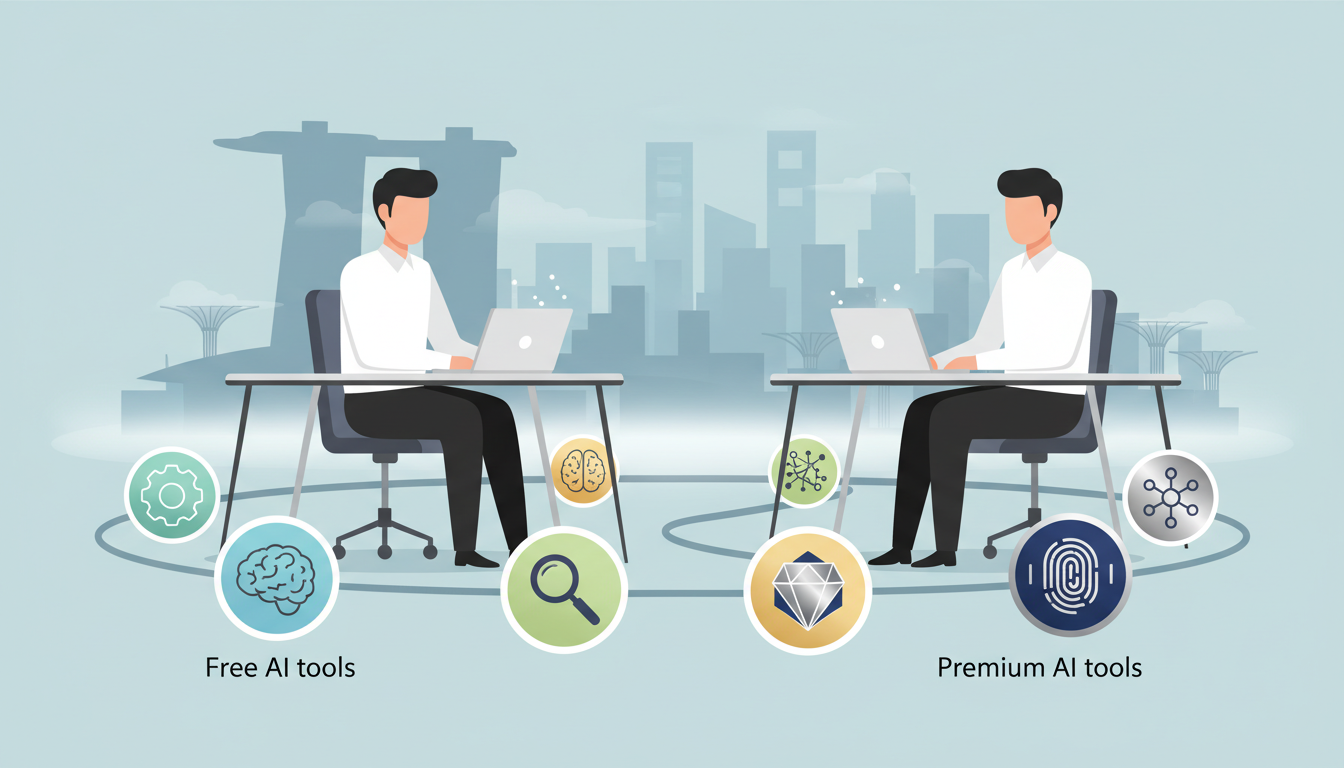
Your colleague just subscribed to ChatGPT Plus. Your manager keeps talking about Microsoft Copilot. Your WhatsApp group is debating whether Gemini Advanced is worth it. Everyone's asking: should I be paying for AI tools, or is free enough? Here's the answer nobody's giving you: for most office workers in Singapore, free AI tools handle 80-90% of what you actually need. But there's a catch—and it's not the one the tech companies want you to think about.
What Do Free AI Tools Actually Offer Singapore Workers?
Let's start with what free AI tools can do right now in 2026, without paying a cent. ChatGPT Free gives you 50-100 messages daily on GPT-4o mini. Google Gemini Free is unlimited for basic tasks. Claude Free offers 20-50 messages per day on their Sonnet 3.5 model. All three can draft emails, summarise reports, explain concepts, generate ideas, and help with basic data analysis—the everyday office tasks most of us actually do.
According to Singapore's Smart Nation trials in 2025, free AI tools provided 30-40% time savings on administrative work for participating government agencies. That's real productivity gain without opening your wallet. These free tiers handle routine work perfectly fine for the vast majority of users. You're not getting an inferior product—you're getting the same core technology with sensible limits that most people never hit anyway.
The catch? Message limits, slower response times during peak hours, and no priority access when everyone's trying to use it at 2pm on a Tuesday. But here's what the marketing doesn't tell you: for typical office use—a few queries a day, drafting emails, quick research—free is genuinely enough. The paid tiers aren't unlocking secret AI superpowers. They're unlocking convenience and higher limits.
Is Paying $20 Per Month for AI Tools Worth It?
ChatGPT Plus, Microsoft Copilot Pro, and Gemini Advanced all cost the same: US$20 per month, approximately S$27. What do you get? Unlimited messages, faster responses, priority access during peak times, and access to more advanced models like GPT-4o or Claude Opus. For heavy users—content creators, researchers, people using AI dozens of times daily—this makes sense. For everyone else? It's worth asking whether you're paying for features you'll actually use.
MIT Technology Review's 2026 analysis found that paid 'reasoning' models like OpenAI's o1 are only 10-15% better than free GPT-4o mini for typical office tasks like email drafting and document summarisation. That's not nothing, but it's also not the revolutionary upgrade the pricing might suggest. If you're drafting standard emails and summarising meeting notes, you're unlikely to notice the difference. Where paid tiers shine: complex analysis, longer documents exceeding 3,000 words, creative work requiring multiple iterations, and reliability when you're on a deadline.
Here's the honest cost-benefit: if you use AI more than 50 times per week for work that directly generates income or saves significant time, paid makes sense. If you're using it occasionally to polish an email or explain a concept, free is fine. The real question isn't 'is paid better'—it is—but 'is it S$324 per year better for what I actually do?' For most Singaporeans, the answer is no.
The Hidden Data Privacy Cost of Free AI Tools
Here's what 'free' really costs: your inputs train their models. Every prompt you type into ChatGPT Free, every document you upload to Gemini, every question you ask Claude—unless you've specifically opted out—becomes training data. OpenAI's Q4 2025 revenue hit US$3.7 billion, with 86% from subscriptions, yet free users still drive 70% of platform traffic according to their investor reports. You're not the customer on the free tier. You're the product.
Under Singapore's Personal Data Protection Act (PDPA), companies must obtain consent and be transparent about data use—but most of us clicked 'I agree' without reading how our prompts are stored, analysed, and used to improve AI models. This isn't necessarily sinister, but it's worth understanding. If you're inputting client information, business strategy, or personal details into free AI tools, you're potentially sharing that with the company's training pipeline. PDPA violations can carry fines up to S$1 million for organisations, but the Act also protects individuals' rights to know how their data is used.
Paid tiers often include stronger data protection—ChatGPT Plus, for example, doesn't use your conversations for training by default, and enterprise versions offer even stricter guarantees. But 'often' isn't 'always,' and the devil's in the terms of service. Before you assume paid equals private, read what you're actually getting. According to 2025 research from Stanford's AI Index, enterprise AI tools reduce hallucination rates from 20% to 5%—but they also create an audit trail your employer can access. Free or paid, the privacy trade-off exists. The question is who you're trading with and what they're doing with it.
What Do Singapore's 2026 AI Rules Mean for Workers?
On 22 January 2026, Singapore launched the Model AI Governance Framework for Agentic AI at the World Economic Forum in Davos. Sounds impressive lah. But here's what it actually means for you as an individual user: probably not much—yet. The framework targets autonomous AI agents that can take actions independently—think AI assistants that book flights, make purchases, or send emails without asking you first. That's different from ChatGPT waiting for your next prompt.
The Monetary Authority of Singapore's 2025 consultation revealed that 25% of financial firms piloting agentic AI experienced unauthorised actions during testing—a significant governance concern. That's why the new guidelines require risk assessments, human oversight, and accountability measures—but they're voluntary, and they're aimed at enterprises deploying autonomous AI systems, not individual workers using ChatGPT to draft an email. For now, the framework is about corporate responsibility, not personal use restrictions.
What does matter for you: Singapore's PDPA violations can carry fines up to S$1 million for organisations. If an AI agent your company deploys causes a data breach, there are consequences. The National AI Strategy 2.0 is investing S$1 billion in AI infrastructure while emphasising responsible, human-centric AI use. For working adults, this means your employer should be thinking about AI governance—and you should ask whether they've provided approved, company-paid tools before you start dumping work documents into free consumer AI platforms. The regulation is catching up, but it's not here to protect you from paying for ChatGPT. It's here to protect everyone from AI systems that act without human control.
When Should You Actually Pay for AI Tools?
So when should you actually pay? Here's the practical breakdown based on actual usage patterns. Stick with free if: you use AI fewer than 10 times per week, your tasks are straightforward (emails, summaries, explanations), you can work around message limits, and you're okay with occasional slower response times during peak hours (typically 10am-3pm Singapore time). You hit about 80-90% of what AI can do for typical office work, and you're not leaving much on the table.
Consider paying if: you use AI daily for work that generates income, you need reliability during peak hours (paid tools had 15% fewer outages in Q1 2026 according to third-party monitoring), you're working with documents exceeding 10,000 words that free limits can't handle, or you need integrations with other productivity tools your work depends on. The upgrade is about volume and reliability, not magic. It's the difference between public transport and a private car—both get you there, but one's faster and more comfortable if you can justify the cost.
But before you pull out your credit card, check this first: does your company already provide AI tools? Many Singapore organisations now offer Microsoft Copilot (included in Microsoft 365 E3/E5 licenses), enterprise ChatGPT, or other platforms as part of workplace software. According to IMDA's 2025 Digital Economy Report, 42% of Singapore SMEs now provide some form of AI tooling to employees. If your employer is paying, use those—they come with better data protection under business agreements and company-appropriate usage policies. Don't spend your own S$324 per year on something your IT department might already be providing or should be providing if the work justifies it. And if you do pay personally, keep work and personal use separate. Your productivity gain isn't worth a PDPA headache or an awkward conversation with HR about client data ending up in a consumer AI platform.
◆Key Takeaway
Here's the bottom line: free AI tools are genuinely useful and handle most everyday office work without requiring a subscription. The paid tiers are better—faster, more reliable, with higher limits—but for most working adults in Singapore, they're not S$324 per year better unless you're a heavy user exceeding 50 uses per week.\n\nBefore you subscribe, ask yourself these three questions: How often do I actually hit the free limits? Am I using AI for income-generating work or just convenience? Does my company already provide tools I'm not using? The answer might be that free is enough—and that's okay. You're not missing out. You're being smart about where your money goes. And if you do decide to pay, go in with your eyes open about what you're getting, what it costs, and what you're trading away in terms of data and privacy under Singapore's PDPA. The best AI tool is the one you'll actually use responsibly, whether it's free or paid."
This article reflects the author's personal views and analysis — not professional technology consulting advice.
The author advocates for responsible AI use and may hold critical views of certain companies and their practices.